
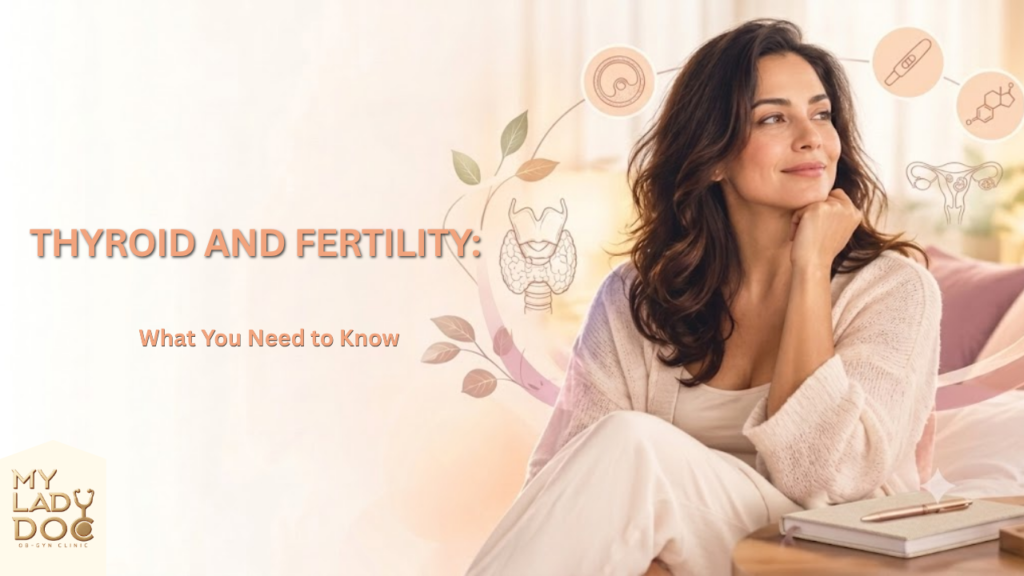
Can thyroid problems affect fertility?
Yes. Thyroid health can affect fertility, particularly when thyroid hormone levels are significantly abnormal rather than only mildly off.
The thyroid is a small gland in the front of the neck, but its hormones influence many body functions, including metabolism, menstrual cycles and reproductive processes. Both an underactive thyroid, called hypothyroidism, and an overactive thyroid, called hyperthyroidism, can interfere with normal reproductive function.
An important point is that an abnormal thyroid test doesn’t automatically mean thyroid disease is the reason you’re having difficulty conceiving. Fertility has many possible causes, and thyroid function is only one part of the evaluation, not the whole picture by itself.
For women who are trying to conceive, the situation becomes especially relevant if periods have become irregular, ovulation is inconsistent, there’s a known thyroid condition, or symptoms suggest that thyroid function may be abnormal.
Current thyroid guidance also recognizes that thyroid care needs to change across the reproductive stages, from preconception through pregnancy and after delivery. The American Thyroid Association published updated guidelines in 2026 covering thyroid disease during preconception, pregnancy and the postpartum period.
How does the thyroid affect fertility?
Thyroid hormones interact with several systems involved in reproduction, not just metabolism as many people assume.
When thyroid hormone levels are significantly too low or too high, they can affect the menstrual cycle and ovulation. If ovulation doesn’t happen regularly, the opportunity to become pregnant can decrease accordingly.
Hypothyroidism can also be associated with changes such as heavier or irregular periods. Hyperthyroidism may cause lighter or less frequent periods in some women, a somewhat different pattern.
The connection isn’t simply about having a “normal” thyroid test. Doctors consider symptoms, thyroid-stimulating hormone (TSH), thyroid hormone levels, medical history and, when appropriate, thyroid antibodies, weighing all of these together.
This matters because menstrual changes can have many causes. PCOS, perimenopause, high prolactin, significant weight changes, stress, excessive exercise and problems involving the ovaries or reproductive tract can also affect ovulation.
So if your periods are irregular, thyroid disease is one possible explanation, not a diagnosis that can be made from the symptom alone.
Hypothyroidism and fertility
Hypothyroidism means the thyroid gland doesn’t produce enough thyroid hormone for the body’s needs.
One of the most common causes is Hashimoto’s thyroiditis, an autoimmune condition in which the immune system attacks thyroid tissue. Other causes include previous thyroid surgery, certain medications, iodine-related problems and treatment for hyperthyroidism.
Hypothyroidism can affect reproductive health in several ways. Women with untreated or inadequately treated overt hypothyroidism may have:
- Irregular or heavy menstrual periods
- Problems with ovulation
- Difficulty conceiving
- Changes in prolactin levels
- Increased risk of pregnancy complications once pregnant
Severe or overt hypothyroidism has a clearer association with reproductive problems than mild thyroid abnormalities do. The American Society for Reproductive Medicine (ASRM) notes that overt hypothyroidism can affect reproductive outcomes, including infertility and miscarriage.
This doesn’t mean every woman with a mildly elevated TSH will have difficulty becoming pregnant, even though it’s tempting to read it that way.
That distinction is important because thyroid testing is sometimes interpreted too aggressively, especially when a single mildly abnormal result is treated as the explanation for infertility without further context.
What is subclinical hypothyroidism?
Subclinical hypothyroidism means the TSH level is above the relevant reference range while the thyroid hormone level, usually free T4, remains within the normal range.
It’s different from overt hypothyroidism, where thyroid hormone levels are also abnormal, not just TSH.
Subclinical hypothyroidism is one of the areas where fertility medicine has had considerable debate. Research hasn’t shown that every mild TSH elevation causes infertility, and treatment doesn’t automatically improve the chance of pregnancy for every woman diagnosed with it.
The 2024 ASRM guideline concluded that there’s insufficient evidence to tell women that subclinical hypothyroidism itself causes infertility. It also found that treatment with levothyroxine hasn’t been shown to improve clinical pregnancy or live birth outcomes for all women with subclinical hypothyroidism who are trying to conceive.
This is why your doctor should interpret a TSH result in context rather than using one number as a universal fertility target to chase.
Can thyroid problems cause irregular periods?
They can, and this is often one of the earlier signs women notice.
Thyroid hormones influence the reproductive system, so significant thyroid dysfunction can interfere with the normal menstrual cycle.
If your periods suddenly become much heavier, lighter, more frequent, less frequent or stop altogether, thyroid disease is one of several possible causes worth considering.
For example, a woman who previously had predictable periods but begins going several months without menstruating may have a thyroid problem, PCOS, high prolactin, perimenopause or another condition affecting ovulation. The symptom alone doesn’t point to one cause over another.
A medical evaluation can help separate these possibilities properly.
ASRM recommends thyroid testing in women with symptoms or signs of thyroid dysfunction, including irregular menstrual cycles, rather than automatically testing every woman with infertility regardless of symptoms.
Can high thyroid levels affect fertility?
Yes. Hyperthyroidism occurs when the body has too much thyroid hormone circulating.
One common cause is Graves’ disease, an autoimmune condition that stimulates the thyroid to produce excessive hormone.
Hyperthyroidism can affect menstrual patterns and ovulation. If untreated, it can also create health concerns during pregnancy that need to be managed carefully.
Symptoms may include:
- Racing or unusually fast heartbeat
- Feeling unusually hot or sweaty
- Shaking or tremors
- Unexplained weight loss
- Anxiety or restlessness
- Difficulty sleeping
- Muscle weakness
- Changes in menstrual periods
These symptoms aren’t specific to hyperthyroidism. Anxiety, medication effects, menopause and other medical conditions can produce similar symptoms, which is why they alone can’t confirm a diagnosis.
A blood test is needed to determine whether the thyroid is actually overactive rather than something else causing these symptoms.
Should you have a thyroid test if you are trying to conceive?
It depends on your individual situation rather than being a blanket recommendation.
Routine thyroid screening for every woman trying to conceive isn’t universally recommended. However, testing is particularly relevant if you have symptoms of thyroid disease or risk factors such as a personal or family history of thyroid problems.
Testing may also be considered when menstrual cycles are irregular or there’s another reason to suspect thyroid dysfunction.
ASRM’s current infertility guidance recommends TSH and T4 testing when symptoms or signs suggest hypothyroidism rather than automatically testing every woman with infertility as a matter of routine.
Your doctor may consider thyroid testing if you have:
- A previous diagnosis of thyroid disease
- A family history of thyroid disease
- Irregular menstrual cycles
- Symptoms suggesting hypothyroidism or hyperthyroidism
- A thyroid enlargement or nodule
- Certain autoimmune conditions
- Previous thyroid surgery or treatment
- A history that makes thyroid dysfunction more likely
The exact testing plan should be individualized to your circumstances rather than following a fixed checklist.
Which thyroid tests are used for fertility?
The first blood test is usually TSH, or thyroid-stimulating hormone, which serves as the initial screening measure.
TSH is produced by the pituitary gland and acts as a signal telling the thyroid how much hormone to produce.
Depending on the result and clinical situation, your doctor may also check free T4, which measures the circulating thyroid hormone available to the body’s tissues.
Other tests may be useful in selected situations, though not routinely for everyone.
Thyroid antibodies
Thyroid peroxidase antibodies, commonly called TPO antibodies, can indicate autoimmune thyroid disease such as Hashimoto’s thyroiditis.
Another antibody test is thyroglobulin antibody testing, used less commonly.
However, thyroid antibodies shouldn’t simply be ordered for every woman with infertility without a specific reason. The evidence surrounding thyroid antibodies and fertility outcomes is mixed, and ASRM does not recommend routine screening for thyroid autoimmunity in asymptomatic women with infertility. Targeted testing may be considered in certain circumstances, such as recurrent pregnancy loss.
Why one thyroid number is not enough
A TSH result should be interpreted according to the laboratory’s reference range, whether you’re trying to conceive or already pregnant, and your medical history, rather than in isolation.
Pregnancy itself changes thyroid physiology, so pregnancy-specific interpretation is different from interpretation in a non-pregnant woman, which is an important distinction to keep in mind.
This is one reason you shouldn’t compare your thyroid result directly with a friend’s result or an internet “ideal TSH” chart, since context matters so much here.
What TSH level is needed to get pregnant?
There’s no single TSH number that guarantees pregnancy, however often this idea circulates.
This is one of the most misunderstood parts of thyroid and fertility care.
For women who aren’t yet pregnant, TSH is generally interpreted using the non-pregnant laboratory reference range. ASRM specifically states that pregnancy-specific TSH thresholds shouldn’t simply be applied to women who are still trying to conceive.
Once pregnancy occurs, thyroid hormone requirements and laboratory interpretation change, sometimes significantly.
If you already have hypothyroidism and take levothyroxine, your doctor may want your thyroid function optimized before conception because thyroid hormone requirements commonly increase during pregnancy.
The appropriate target depends on your diagnosis, treatment, laboratory reference ranges and whether you’re pregnant, so it isn’t a fixed number that applies universally.
It’s therefore better to ask, “Is my thyroid function appropriately controlled for pregnancy?” rather than trying to achieve a particular TSH value on your own based on something you read.
Does treating hypothyroidism improve fertility?
Treating overt hypothyroidism is important for general health and reproductive care alike.
When thyroid hormone deficiency is significant, treatment can restore thyroid hormone levels and may help correct menstrual and ovulatory problems caused by the thyroid disorder.
The standard treatment for hypothyroidism is usually levothyroxine, a synthetic form of thyroxine (T4). The dose is individualized according to the person’s thyroid function and clinical situation.
Mild or subclinical hypothyroidism is different, and the decision-making is more nuanced. Treatment decisions are more complicated because evidence doesn’t show that giving levothyroxine to every woman with a mildly elevated TSH improves fertility outcomes.
ASRM’s 2024 guideline specifically concluded that levothyroxine treatment of subclinical hypothyroidism in women desiring pregnancy hasn’t been demonstrated to improve clinical pregnancy or live birth outcomes.
That doesn’t mean treatment is never appropriate. It means the decision should be based on the degree of thyroid abnormality, pregnancy status, symptoms, thyroid antibodies and other clinical factors weighed together.
Never start, stop or change thyroid medication without medical advice, even with a strong personal conviction about what might help.
What happens if you become pregnant with hypothyroidism?
If you have known hypothyroidism and become pregnant, thyroid care becomes more important because pregnancy increases the body’s need for thyroid hormone considerably.
The thyroid has to support both maternal needs and the developing pregnancy simultaneously. Women already taking levothyroxine often need a dose adjustment early in pregnancy, followed by repeat blood tests to make sure thyroid hormone levels remain appropriate.
The American Thyroid Association recommends prompt thyroid testing after pregnancy is confirmed for women with established hypothyroidism and emphasizes close monitoring throughout pregnancy.
The 2026 ATA guidelines have updated recommendations covering thyroid function testing and treatment across preconception, pregnancy and the postpartum period.
This is one reason women with known thyroid disease should ideally discuss pregnancy planning with their doctor before conception rather than waiting until the first prenatal appointment to bring it up.
Why does thyroid control matter during pregnancy?
Thyroid hormone is important for maternal health and fetal development, playing a role that extends well beyond the mother’s own metabolism.
Untreated severe hypothyroidism during pregnancy can be associated with pregnancy complications and problems with fetal development. Appropriate treatment can reduce the risks associated with significant thyroid hormone deficiency.
The opposite problem, poorly controlled hyperthyroidism, can also create pregnancy concerns that need attention.
The goal isn’t to keep thyroid numbers “perfect” by yourself through guesswork. It’s to identify thyroid disease when appropriate, use pregnancy-specific reference ranges, and adjust treatment under medical supervision.
What if you have Hashimoto’s thyroiditis and want to get pregnant?
Hashimoto’s thyroiditis is an autoimmune condition and a common cause of hypothyroidism.
Having Hashimoto’s doesn’t mean you can’t become pregnant, a fear that comes up often in consultations.
Many women with Hashimoto’s conceive and have healthy pregnancies, particularly when thyroid hormone levels are appropriately managed throughout.
If you know you have Hashimoto’s and are planning pregnancy, tell your obstetrician or gynecologist and, when appropriate, your endocrinologist. Your doctor can review your recent TSH and thyroid hormone results and decide whether medication needs to be adjusted before conception.
Thyroid antibodies may remain positive even when thyroid hormone levels are normal. A positive antibody test by itself doesn’t mean that pregnancy will be unsuccessful, despite how concerning the result might look on paper.
The treatment decision depends on the overall clinical picture rather than the antibody result alone.
Does thyroid disease increase miscarriage risk?
Overt, untreated hypothyroidism and some forms of thyroid dysfunction have been associated with adverse reproductive outcomes, including miscarriage.
However, it isn’t accurate to say that every abnormal TSH level causes miscarriage, since the relationship is more nuanced than that.
This is particularly relevant for subclinical hypothyroidism, where the evidence is less straightforward. ASRM’s 2024 guideline found that mild TSH elevations in certain ranges weren’t associated with increased miscarriage risk and concluded that evidence was insufficient to link subclinical hypothyroidism broadly with infertility.
Thyroid antibodies are another area where research has produced mixed findings. A positive TPO antibody result should therefore be interpreted alongside TSH, thyroid hormone levels and pregnancy history rather than treated as a prediction of miscarriage on its own.
If you’ve had recurrent pregnancy loss, your doctor may investigate thyroid function as part of a broader evaluation rather than as the sole focus.
Thyroid and IVF: does thyroid function matter?
Thyroid function can be relevant during fertility treatment, but an abnormal thyroid test doesn’t automatically mean IVF will fail.
Women undergoing assisted reproductive treatment may have thyroid testing based on their history, symptoms, existing thyroid disease or the fertility clinic’s clinical approach, which can vary somewhat between practices.
Research into mild thyroid abnormalities and assisted reproduction has produced mixed results. ASRM’s current guideline does not support automatically treating every woman with subclinical hypothyroidism simply to improve fertility outcomes.
If you’re preparing for IVF or another fertility treatment and have known thyroid disease, your fertility specialist can coordinate thyroid management with your endocrinologist or gynecologist.
The important question isn’t simply whether your TSH is below a particular number. It’s whether your thyroid condition is appropriately assessed and managed for your individual treatment plan.
Can thyroid medication help you ovulate?
If thyroid dysfunction is interfering with ovulation, treating the underlying thyroid disorder can help restore normal reproductive function in some women.
But levothyroxine isn’t a general fertility medicine, and it’s worth being clear about that distinction.
If your thyroid function is normal, taking thyroid medication doesn’t automatically improve ovulation or increase your chances of pregnancy. Similarly, a mildly abnormal TSH shouldn’t be assumed to be the cause of infertility without proper evaluation of other possibilities.
Fertility treatment should address the actual reason for difficulty conceiving, whatever that turns out to be.
Depending on the situation, that may involve assessing ovulation, ovarian reserve, fallopian tubes, the uterus and the male partner’s fertility as well.
When should you see a doctor about thyroid and fertility?
Consider discussing thyroid testing and fertility with a doctor if:
- Your periods are consistently irregular.
- You have a known thyroid disorder and want to conceive.
- You have symptoms suggesting thyroid dysfunction.
- You have previously had thyroid surgery or treatment.
- You have a family history of thyroid disease and other risk factors.
- You have experienced recurrent pregnancy loss.
- You are having difficulty conceiving.
- You are planning IVF or another fertility treatment.
- You become pregnant while taking thyroid medication.
Age also matters when deciding how long to try before seeking fertility evaluation. If you’re over 35 and have been trying to conceive for six months without pregnancy, fertility evaluation is generally appropriate; women over 40 may benefit from evaluation before trying. Thyroid assessment can be one part of that evaluation when clinically indicated, not necessarily the starting point.
What should you do before trying to conceive?
If you have thyroid disease, a preconception appointment is a useful step to take early.
Bring your recent thyroid reports and a list of medications and supplements you take. Your doctor can review whether your thyroid condition is stable and whether any treatment needs to be adjusted before pregnancy.
It’s also worth discussing:
- Your menstrual cycle pattern
- Previous pregnancies and miscarriages
- Current thyroid diagnosis
- Previous TSH and free T4 results
- Thyroid antibodies, if already tested
- Other medical conditions
- Current medications
- Fertility history
- Family history of thyroid or autoimmune disease
- Prenatal vitamins and folic acid
- Any planned fertility treatment
This conversation can prevent a common problem: discovering an uncontrolled thyroid condition only after pregnancy has already begun, when adjustments become more urgent.
Do you need a special diet for thyroid-related fertility problems?
Usually, there’s no special “thyroid fertility diet” that can correct infertility, whatever certain wellness content might claim.
A balanced diet is useful for general health, but foods or supplements shouldn’t be treated as substitutes for appropriate thyroid treatment.
Iodine deserves particular care in this context. Iodine is required to make thyroid hormones, and both too little and too much iodine can be problematic. Pregnancy also changes iodine requirements. Your doctor can advise you about prenatal supplements and iodine intake based on your circumstances.
Be cautious with supplements marketed as “thyroid support” or “fertility boosters.” Some contain large amounts of iodine or thyroid-related ingredients that may interfere with medical treatment rather than help it.
If you take levothyroxine, ask your doctor or pharmacist how to take it with other medicines and supplements, because some products can interfere with its absorption in ways that aren’t obvious.
Thyroid symptoms can be easy to overlook
Thyroid disease doesn’t always announce itself clearly, which is part of why it can go unnoticed for a while.
Fatigue, weight changes, hair loss, constipation, anxiety, poor sleep and changes in periods can have many explanations. A woman trying to conceive may assume that stress or lifestyle is responsible when a thyroid problem is also present underneath.
At the same time, it’s easy to go too far in the opposite direction and blame every symptom on the thyroid without evidence.
That’s why blood testing and clinical evaluation matter so much here.
A symptom can suggest that thyroid testing is worth considering, but the test result and the broader clinical picture are what actually establish whether thyroid dysfunction is present.
The bottom line
Thyroid health and fertility are connected, particularly when thyroid hormone levels are significantly abnormal. Untreated overt hypothyroidism or hyperthyroidism can interfere with reproductive function and create additional concerns during pregnancy.
Milder thyroid abnormalities are more complicated. Not every mildly elevated TSH causes infertility, and current evidence does not support treating every woman with subclinical hypothyroidism simply to increase the chance of pregnancy.
If you already have thyroid disease and are planning pregnancy, don’t wait until you’re pregnant to ask whether your thyroid is adequately controlled. A preconception consultation gives your gynecologist or thyroid specialist an opportunity to review your condition and plan monitoring ahead of time.
For women seeking fertility or gynecological care in Bangalore, a consultation with Dr. Hiba Gul at MyLadyDoc can help put menstrual changes, thyroid concerns and pregnancy planning into the wider context of your reproductive health.
The goal isn’t to chase one “perfect” thyroid number. It’s to understand what your results mean, treat genuine thyroid disease appropriately and make a pregnancy plan based on your individual health.
Frequently Asked Questions
Can hypothyroidism make it harder to get pregnant?
Untreated or inadequately treated overt hypothyroidism can interfere with menstrual cycles and ovulation and may contribute to difficulty conceiving. Mild thyroid abnormalities are different, and current evidence does not show that every case of subclinical hypothyroidism causes infertility. If your periods are irregular or you have known thyroid disease, your doctor can determine whether thyroid dysfunction may be affecting fertility.
What thyroid test should I have when trying to conceive?
TSH is usually the starting thyroid blood test. Depending on your result, symptoms and medical history, your doctor may also check free T4 and, in selected situations, thyroid antibodies such as TPO antibodies. Thyroid testing is particularly relevant when you have symptoms, irregular periods, a history of thyroid disease or other risk factors.
What TSH level is best for fertility?
There is no single TSH level that guarantees pregnancy. For women who are trying to conceive but are not pregnant, thyroid results are generally interpreted using the non-pregnant laboratory reference range. Once pregnancy occurs, thyroid physiology changes and pregnancy-specific reference ranges are used. Your doctor should interpret TSH together with your thyroid hormone levels and medical history.


![]Labiaplasty Recovery Guide](https://myladydoc.com/wp-content/uploads/2026/09/Menopause-HRT-in-2026-3-150x150.png)